
A garage door that will not close is one of the few household faults that is genuinely urgent — you cannot leave the house open and you cannot always leave the car out. The good news is that most of the causes are cheap, and about half of them you can diagnose from the driveway in under five minutes. Here is how we work through it on a callout, in the order we check.
Before anything else: is it the door or the motor?
Pull the manual release cord and try to move the door by hand. This one test splits the problem in two.
- The door moves smoothly by hand. The mechanism is fine. You have a motor, power or safety-sensor problem — faults 1 to 4 below.
- The door is heavy, sticks, or will not budge. The motor is not your problem. You have a spring, cable, roller or track fault — faults 5 to 9.
A balanced door should hold its position roughly halfway up when released. If it slams down or shoots up, the counterbalance is out. Stop there and call someone: a door under wrong spring tension is the one part of this list that genuinely hurts people.
1. The safety sensors are misaligned or blocked
This is the single most common cause, and the easiest to fix. Two photo-eye sensors sit near the floor on either side of the opening. If the beam between them is broken, the operator refuses to close — it will usually open again immediately and flash a code on the motor head.
Check: a bin, a bicycle wheel, a coiled hosepipe, a broom, even a spider web or a heavy build-up of dust on the lens. Then check the little indicator LEDs: one steady light on each sensor means aligned; a flickering or dark light means they are out of line. Loosen the bracket, nudge until both are steady, tighten.
Also worth knowing: low winter sun shining directly into a sensor can wash out the beam for twenty minutes a day. If the fault only happens at the same time each afternoon, that is why.
2. The close-limit setting has drifted
The operator learns how far to travel. If it thinks the floor is lower than it is, the door touches down, senses resistance, and reverses — because it assumes it has hit a child or a car. You will see the door go all the way down then come straight back up.
There is a limit adjustment on the motor head, usually two screws or two buttons marked up and down. Small adjustments only. If you overshoot the other way, the door will press into the slab and strain the opener.
3. The remote or wall button has failed
If the wall button works and the remote does not, it is the remote: replace the battery first, then re-pair it. If neither works but the motor has power, the receiver or the logic board is the suspect. If the door closes only while you hold the wall button down, the operator is in a fault mode that deliberately requires constant pressure — that is the unit telling you a safety circuit is unhappy, so go back to fault 1.
4. No power, or a tripped unit
Obvious, and still worth ruling out. Check the plug, the socket and the DB board. After a surge — and we get plenty — an operator can trip internally and need a full power cycle: switch it off at the wall for a minute, then back on. If the unit runs on battery backup after load-shedding and never switched back to mains, it will eventually go flat and stop mid-cycle.
5. A broken spring
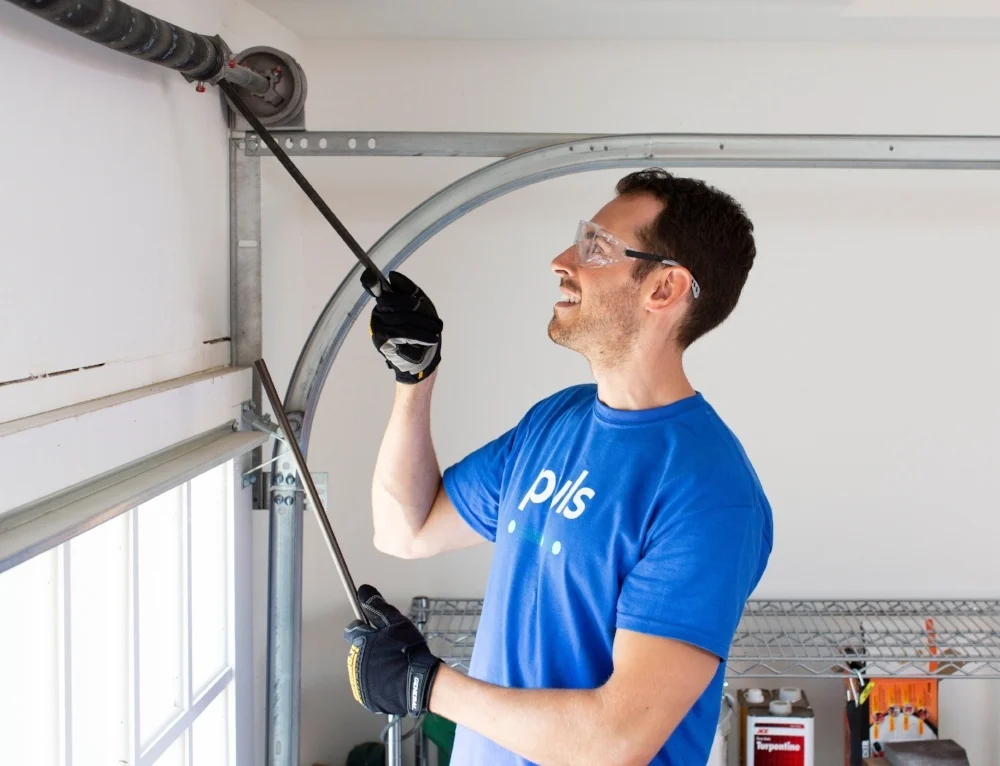
Torsion springs sit above the opening; extension springs run alongside the tracks. They are what makes a 90kg door feel like 10kg. When one breaks you often hear a bang like a gunshot from the garage, and afterwards the door is enormously heavy and may close crooked or not at all.
Do not attempt this yourself. A wound torsion spring stores a great deal of energy and the winding bars have to be handled correctly. This is the repair we most often attend after somebody has tried it. Springs are also fitted in matched pairs; replacing only the broken one leaves you replacing the other within months.
6. A frayed or off-drum cable
Lift cables run from the bottom bracket to the drum at each end of the torsion shaft. If one frays or jumps its drum, one side of the door lags, the door goes out of square in the tracks and jams. You will see the door hanging visibly lower on one side.
Look at the bottom brackets and the cables with a torch. Any fuzzy or kinked strand means the cable is on its way out. Cables are inexpensive; the damage a snapped one does on the way is not.
7. Worn rollers, or something in the track
Rollers wear out, especially the nylon ones. A worn roller binds in the track and the door judders, squeals or stops. Run a torch along both tracks looking for a dent, a loose bracket, a screw head that has worked proud, or a build-up of hardened grease and grit.
A track dent is often the result of a reversing bumper. It can sometimes be tapped straight; if the track is kinked, replace that section rather than fighting it.
8. The tracks have come out of alignment
Vertical tracks should be plumb and parallel, at an even distance from the door edge along their full length. Bolts that have vibrated loose over years let a track drift outward, and the door then binds at one particular height every time. Loosening the bracket bolts, tapping the track true and re-tightening solves it — but if you are unsure, leave it, because a track pushed the wrong way will drop the door.
9. Cold, dirt and a dry bottom seal
The unglamorous one. Grit packed into the bottom seal or under the track, or a rubber seal that has perished and stiffened, will stop a door seating properly and trigger the reverse. Sweep the track channel, wash the seal, and lubricate the rollers, hinges and springs with a proper garage door lubricant — not a general water-dispersant spray, which strips the grease and leaves the parts drier than it found them.
What you can safely do yourself
- Clean and realign the photo-eye sensors.
- Replace remote batteries and re-pair the remote.
- Clear the tracks and the bottom seal, and lubricate moving parts.
- Power-cycle the operator.
- Make small limit adjustments, one turn at a time.
What to leave alone
- Anything involving torsion or extension springs.
- Lift cables and bottom brackets, which are under spring tension even when the door is down.
- Realigning tracks on a door you cannot hold safely.
- Opening the motor head beyond the limit adjusters.
When to call
Call if the door is heavy by hand, if you can hear a spring has gone, if a cable looks frayed, or if the door is closing crooked. Those four are not “watch it for a week” faults — a door that is out of balance puts load on every other component, so a R900 spring left alone becomes a bent track and a burnt-out operator.
We run 24-hour emergency callouts and repair garage doors of any make, including doors we did not fit. Most faults on this list are resolved in a single visit with parts off the van. If you would rather get ahead of it, a yearly service catches all nine of these before they strand you.
Not sure which fault you have? Send us a photo of the door and the motor head and we will tell you what we think it is before anyone gets in a van.