
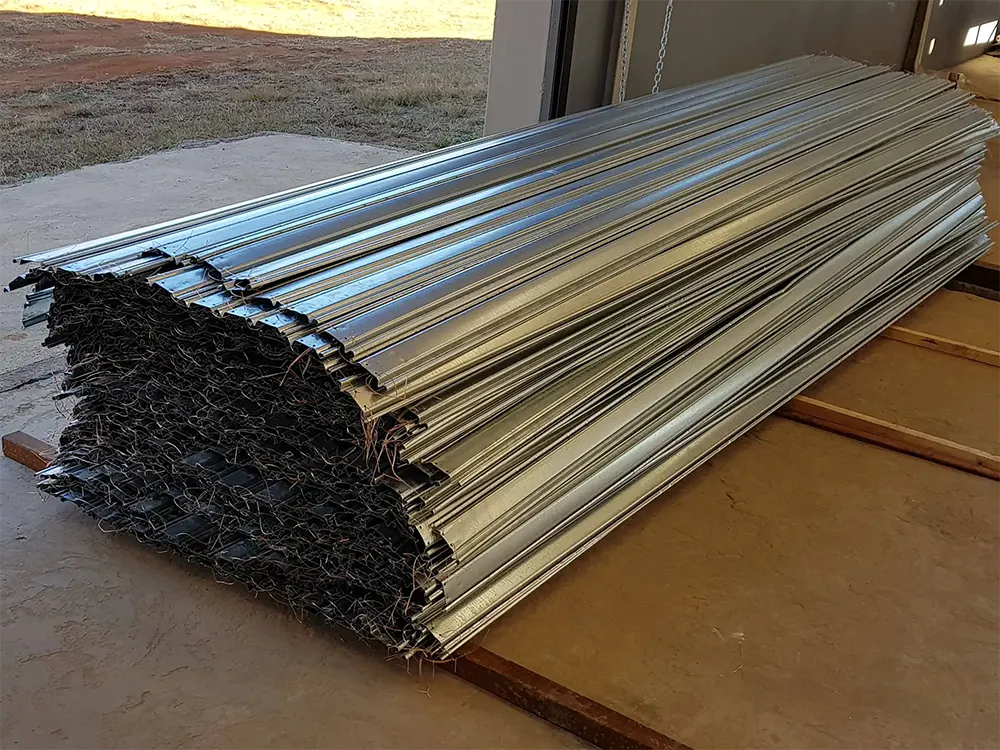
Roller shutter doors rarely fail without warning. They get slower, noisier and heavier for weeks before they stop, and in Sandton that warning period is usually ignored because the door is in a basement or a service corridor that nobody looks at. Catching it at the noisy stage is the difference between a spring replacement and a new curtain.
Common roller shutter door faults we repair in Sandton
The failure list is short and, after two decades, predictable:
- Torsion springs at end of cycle life. Fatigue is counted in cycles, not years. A basement gate on a Sandown office block doing two hundred cycles a day reaches its design life in a fraction of the time of a warehouse door in Wynberg opened twice.
- Drifting limit switches. The door stops short of the floor or strains against it. Almost always an adjustment, not a replacement.
- Bottom rails hit by vehicles. The standard Kramerville and Marlboro call. Slats are replaceable individually, so this is a repair, not a new door.
- Guides packed with grit and old lubricant. The single most common cause of a door an owner has already written off as finished.
- Burnt-out operators. Usually a motor that was never rated for the door hung on it.
Roller shutter door repairs on any make
We repair every make we come across in Sandton, including doors installed by companies that are no longer trading. Where the original guide or bottom rail profile has been out of production for years, we fabricate a replacement to profile at our own works rather than telling you the door has to be replaced. On a structurally sound curtain that is almost always the cheaper answer.
Our roller shutter door repair process
A technician diagnoses on site rather than quoting from a phone description. Our vehicles carry springs, cables, slats, bottom rails, guides, limit switches and common operators, so the majority of Sandton repairs are finished on the first visit. If a part has to be made, we tell you the date at the point of diagnosis and secure the opening in the meantime.
Roller shutter door repair or replacement
We price both and give you our recommendation. A curtain with sound slats, straight guides and a serviceable box is worth repairing even after significant damage. A curtain worn through at the edges along its length is not, and we will say so rather than take payment for a repair that returns in six months.
Roller shutter door repairs for Sandton businesses
Shopfront and retail work is done before opening or after close so no trading time is lost. Basement gates on the office towers are done outside peak arrival and departure so a level is never fully closed during business hours. Contractor induction, insurance documents and access clearance are arranged before the team is dispatched, not on the morning.
Book a roller shutter door repair in Sandton
Send us the address and a short description of what the door is doing, or a video if it is a noise. Survey is free anywhere in Sandton, the quotation is written and itemised, and emergency breakdowns are attended around the clock.
Common questions
About roller shutter door repairs
A curtain with a few damaged slats near the bottom does not need replacing — those slats swap out individually. A door with a corroded curtain, worn guides and a failing drive is throwing good money after bad. We will tell you which one you have, and we would rather lose the sale than string out repairs on a door that is finished.
It depends entirely on what failed. A limit switch reset is a call-out fee. A spring replacement on a wide industrial door is a bigger job with two technicians. We quote after diagnosis rather than over the phone, because a phone estimate for a door nobody has looked at is a number that changes later.
Torsion springs, by a distance — their life is measured in cycles, so a door opened forty times a day wears far faster than one opened twice. After that: limit switches drifting out of adjustment, guide rails packed with debris, and bottom rails bent by forklifts.
Yes. Roller shutters are the bulk of our work, but we service sectional overhead doors and high-speed fabric doors as well, on industrial and commercial sites.
Anything that has left a building unsecured is attended the same day, and emergencies around the clock. Routine repairs are usually same or next day. Because our vehicles carry the parts that fail most often, the majority of Sandton repairs are finished on the first visit rather than booked back.
Related
Also worth a look
Garage Door Motors and Automation
Supply, replace, automate
Garage door motor supply, replacement and automation. Manual doors converted, failed operators replaced, and battery backup so load shedding does not leave you locked…
Read more about Garage Door Motors and AutomationRoller Shutter Door Service Contracts and Maintenance
SLA cover for buildings and estates
Contracts written for managed buildings: scheduled visits, response times you can quote to a tenant, and a report after every visit.
Read more about Roller Shutter Door Service Contracts and MaintenanceGarage Door Repairs
Domestic and complex, all makes
Garage door repairs on roll-up, sectional and tip-up doors. Broken springs, doors that will not close, motors that hum but do not move —…
Read more about Garage Door Repairs