
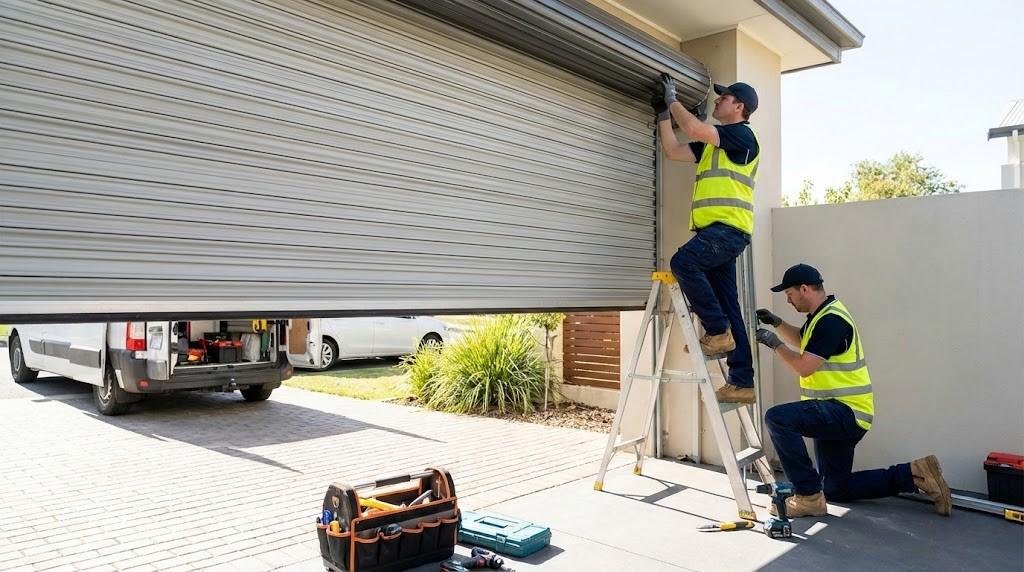
Most installation problems in Sandton are decided before anything is manufactured. The opening is measured badly, the headroom is assumed rather than checked, or the door is specified from a drawing that no longer matches what was built. We survey the structure, not the aperture, and the door is then made to those figures at our own works.
What a roller shutter door installation survey covers
- The opening at several points. Older buildings in the CBD and around Wynberg are rarely square, and a door built to one measurement will bind or leave a gap.
- Headroom and side room. This decides the box size and the operator position, and on basement ramps in Sandton it is frequently the constraint that rules out a standard build.
- The floor across the threshold. A sloped or settled slab is why a door seals on one side and gaps on the other.
- The structure above. If the lintel will not carry the box, steel goes in first and it is priced in the quotation rather than raised later.
- Power and access control. Whether the operator ties into an existing intercom, tag or boom system.
Roller shutter doors made to your opening
Curtains, guides, boxes and bottom rails are cut, rolled and assembled at our own works under an ISO 9001:2015 approved quality system. Because nothing is ordered in a stock size, a narrow service opening in a Rivonia Road office block and a wide loading bay in Linbro Park go through the same process. Gauge and coating are chosen for the duty and the environment rather than applied uniformly.
Our roller shutter door installation process
Fitted by our own crews, never subcontracted. In the Sandton CBD that usually means an early start or an after-hours slot agreed with building management, with loading arranged in advance and the frontage kept safe while the curtain is hung. On industrial sites in Kramerville and Marlboro we phase the work bay by bay so the building keeps operating, and we bring a temporary closure so nothing stands open overnight.
Roller shutter door installation and commissioning
The door is tested under power and by hand. We set and record the travel limits, check the safety edge and photocells where fitted, demonstrate the manual release to whoever will actually need it at seven in the morning, and leave you the service interval for the duty the door will see. Remotes and access integration are paired and tested before we leave site.
Roller shutter door installation lead times
Because every door is built to your measured opening, the lead time is manufacture rather than delivery. That is normally a few working days from the survey for a standard commercial or residential door, longer for fire-rated or large-span work, and we give you the date at quotation rather than an optimistic estimate.
Book a roller shutter door installation in Sandton
A free site survey, then an itemised quotation showing the door, the operator, the installation and any preparation separately. The price is fixed once the work is approved. Workmanship carries a twelve-month warranty and the terms come with the quotation.
Common questions
About roller shutter door installation
A single standard door is usually a one-day fit. Multiple bays are phased so you never lose more than part of your dock or workshop capacity at once. The longer part is manufacture — roughly two to three weeks from accepted quote.
No. Our own teams install what we manufacture. It matters more than it sounds: when installation is subcontracted to whoever is nearest, nobody owns the result, and the warranty conversation a year later becomes an argument about whose fault it was.
A structurally sound opening and, for motorised doors, a power supply at the right side of it. The site survey checks both. If the opening needs steelwork or the power needs moving, that is itemised in the quote rather than discovered on installation day.
Yes, and it is included in most replacement quotes. Say so at survey stage so the team arrives with the right equipment, particularly on wide industrial openings.
Fitting itself is usually a single day. The lead time is manufacture, not delivery, because the door is built to your measured opening: normally a few working days from survey for a standard commercial or residential door, longer for fire-rated or large-span work. We give you the date at quotation.
Related
Also worth a look
Roller Shutter Door Safety and Compliance Inspections
Insurance and audit requirements
Force testing, safety edge and photocell checks, and fire door drop tests — with a written report for your insurance file or audit.
Read more about Roller Shutter Door Safety and Compliance InspectionsRoller Shutter Door Service Contracts and Maintenance
SLA cover for buildings and estates
Contracts written for managed buildings: scheduled visits, response times you can quote to a tenant, and a report after every visit.
Read more about Roller Shutter Door Service Contracts and MaintenanceRoller Shutter Door Spares and Replacement Parts
Springs, motors, slats, tracks
Springs, motors, slats, guide rails and remotes for roller shutter doors of all common makes. Where a door is worth saving, we repair rather…
Read more about Roller Shutter Door Spares and Replacement Parts